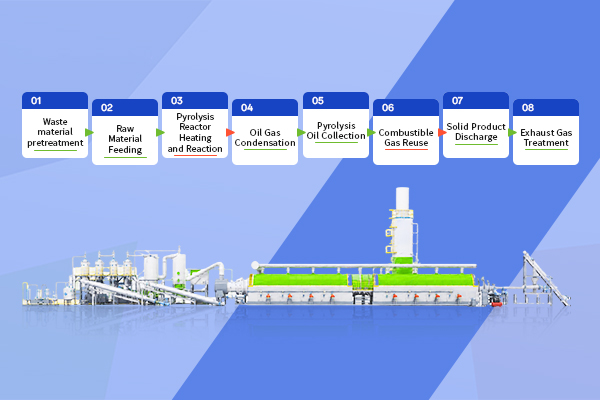
Complete Pyrolysis Recycling Process

A Complete Pyrolysis Recycling Process gives recycling investors a clearer way to evaluate how waste materials become recoverable products. In projects involving waste tires, plastics, oil sludge, aluminum-plastic materials or solar panel residues, pyrolysis is more than a thermal reactor. It is an integrated recycling route that affects material preparation, heating stability, oil-gas recovery, solid residue handling, emission control and long-term operating cost.

Why Does a Pyrolysis Recycling Project Need a Complete Process View?

A process view links waste treatment with product recovery

Many buyers begin with oil yield, reactor size or plant price. These factors matter, but they only show one part of the project. A practical pyrolysis recycling line should be evaluated from the full operating route: how the waste enters the system, how it reacts, how oil vapor is recovered, how combustible gas is reused, and how solid residue is discharged or further separated.

When waste contains moisture, dust, metals, mixed plastics or unstable particle sizes, the front-end preparation stage can directly affect reactor performance. When the buyer expects cleaner fuel oil, reusable carbon residue or better downstream material recovery, the condensation and separation system becomes a decisive part of the whole solution.

Complete pyrolysis process of waste recycling
Product of waste pyrolysis machine

Industry conditions shape equipment configuration

A tire recycling project usually values oil recovery, carbon black handling and steel wire separation. A plastic recycling project may focus more on sorting quality, wax control, condensation efficiency and oil storage. Oil sludge treatment requires safer handling of oil-water-solid mixtures. Solar panel recycling may use pyrolysis to remove EVA or backsheet layers before glass, silicon, copper and silver-bearing materials enter further separation.

This is why the Complete Pyrolysis Recycling Process should be designed around the real recycling business. The same reactor capacity may lead to different results when the waste source, operating rhythm, labor condition and product market are different.

Which Materials Can Enter a Pyrolysis Recycling Line?

Waste tires recovery

  • Oil recovery
  • Carbon black handling
  • Steel wire separation

Plastics to oil disposal

  • Sorting quality
  • Wax control
  • Condensation efficiency
  • Oil storage

Oil sludge thermal treatment

  • Safer handling
  • Oil-water-solid mixtures
  • Stable operation

Solar panel pyrolysis recycling

  • Remove EVA / backsheet
  • Glass, silicon, cuivre
  • Silver-bearing materials
  • Further separation

How Does the Pyrolysis Recycling Process Work Step by Step?

Sorting, shredding, drying, dewatering or frame removal prepares the material for stable feeding and heating. The exact process depends on the feedstock.
Tires may need cutting, plastics require sorting, oil sludge often needs dewatering, and solar panels may need frame removal.

Prepared material enters the reactor through a suitable feeding system. Stable feeding improves reactor loading, heat transfer and oil-gas output.
Uneven feeding may reduce efficiency and disrupt production.

The reactor heats the feedstock under oxygen-free or low-oxygen conditions. Organic components decompose into oil vapor, combustible gas and solid residue.
Stable temperature control improves product recovery and supports safer downstream processing.

Hot oil vapor flows into the cooling system and condenses into liquid pyrolysis oil.
Sufficient cooling area and stable water circulation improve oil recovery. Plastic projects may also need wax-control equipment to prevent pipeline blockage.

The discharge system removes solid residue after the reaction.
Tire projects recover carbon black and steel wire. Plastics produce carbon residue and ash. Oil sludge leaves treated solids, while solar panel processing produces glass, silicon, copper and silver-bearing materials.

Gas purification, dust removal and tail-gas treatment reduce odor, dust and exhaust emissions.
A properly configured environmental system supports cleaner operation, safer working conditions and long-term regulatory compliance.

How Do Batch, Semi-Continuous and Continuous Structures Affect the Project?

Batch operation supports flexible recycling projects

Batch pyrolysis equipment is often suitable for projects with changing waste supply, moderate daily capacity or controlled initial investment. It allows operators to handle different materials with relatively flexible process adjustment. Each cycle includes feeding, heating, reaction, cooling and discharge, so the buyer should pay attention to labor arrangement, cooling time and workshop cleanliness.

This structure is practical for many tire, plastic and oil sludge projects at the early or medium investment stage. It gives investors room to test the waste source, product market and operating team before moving toward higher automation.

Higher continuity serves larger supply chains

Semi-continuous or continuous structures are more suitable when the project already has stable waste collection, stronger pretreatment capability and higher daily processing targets. These systems can reduce repeated cooling and feeding time, but they also require better material preparation, higher automation and stricter operation management.

A larger system should not be selected only because it looks more advanced. The structure should match the supply chain, budget, site condition, labor level and sales route for recovered products. A properly matched plant can keep production more profitable and controllable.

What Makes a Complete Pyrolysis Recycling Process Reliable for Industrial Projects?

Engineering configuration should serve the buyer’s business model

A reliable pyrolysis project should connect waste preparation, reactor design, oil-gas recovery, gas reuse, residue discharge and environmental treatment into one practical route. When these parts work together, the plant can reduce operating interruption, improve product recovery and lower unnecessary management pressure.

Yushunxin designs pyrolysis equipment for recycling projects involving waste tires, plastics, oil sludge and solar panel materials. Our engineering team can configure the line according to the way your project actually operates, including material preparation, reactor structure, heating arrangement, discharge route, condensation system and exhaust treatment.

Yunshuxin support service

Contact Yushunxin to discuss your recycling project, and our team will help you build a Complete Pyrolysis Recycling Process with safer operation, clearer product recovery and stronger long-term project control.