Pyrolysis Machine Price Guide: What Buyers Should Check Before Requesting a Quote

If you are searching for a Pyrolysis Machine Price, you’ve likely noticed that quotes for similar-capacity equipment can vary wildly—one supplier offers $80,000, while another asks for over $150,000. But does a higher price mean better quality, or does a lower one represent better value? The answer is rarely about capacity alone. In most cases, the final quotation reflects a complex combination of reactor design, automation, environmental compliance, and, critically, what’s not included.

As a professional waste pyrolysis equipment manufacturer, Yushunxin provides this guide not to give you a single number, but to help you understand the cost structure. This way, you can compare quotations based on real project value and avoid costly surprises after delivery.
Yushunxin waste recycling pyrolysis machine
$
Understand Real Cost
Price varies by configuration,
not just capacity.
Compare Smartly
Look beyond the quote,
check what's included.
Invest for the Future
Quality equipment ensures
long-term profit.

How Much Does a Pyrolysis Machine Usually Cost?

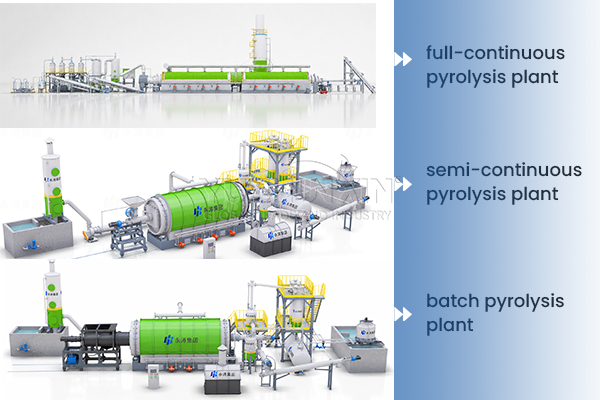
For international recycling projects, the budget primarily depends on the operating mode. A small skid-mounted or pilot unit is ideal for testing feedstock and local markets, typically starting around USD 30,000–60,000. A commercial batch waste pyrolysis machine offers the best entry point for most new projects, ranging from USD 70,000–120,000. For stable, high-volume operations, semi-continuous (USD 150,000–350,000) and fully continuous (USD 600,000+) systems deliver greater efficiency but require higher upfront investment.

Machine Type

Typical Application

Estimated Price Range

Laboratory Unit

Technology testing

USD 30,000–60,000

Batch Plant

Small and medium recycling projects

USD 70,000–120,000

Semi-continuous Plant

Commercial production

USD 120,000–280,000

Fully Continuous Plant

Large industrial recycling facilities

USD 650,000–1,000,000+

What Decides Pyrolysis Machine Price?

Quote

Item Why It Matters

Reactor

Determines heating efficiency, sealing and service life

Feeding System

Affects labor cost and material adaptability

Condensation System

Influences oil recovery and blockage risk

Safety System

Reduces backfire and gas operation risk

Environmental System

Supports local approval and stable operation

Installation Support

Helps overseas projects start faster

Operating Mode Changes the Investment Structure

Batch Pyrolysis Plant — Best for Unstable Feedstock

  • Lower first investment
  • Handles wider material fluctuation
  • Cycle operation: feed, heat, cool, discharge
  • Suitable for mixed plastics, high-moisture or irregular supply
  • Easier to start, easier to adjust
Batch model waste pyrolysis machine

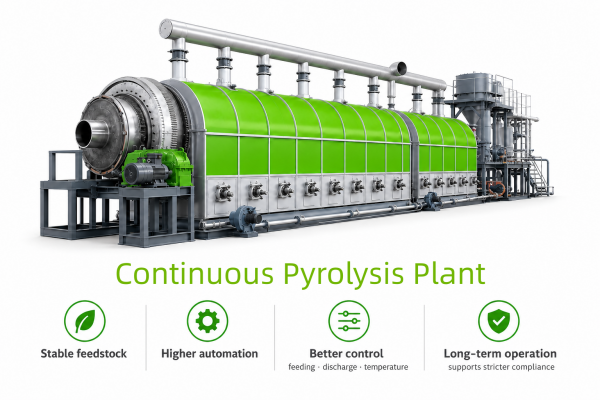
Continuous Pyrolysis Plant — Best for Stable Daily Supply

  • Higher automation investment
  • Better rhythm and labor efficiency
  • Requires sorting and pre-treatment plan
  • Stronger uniformity requirements
  • Better for long-term operation and scale-up
Continuous waste recycling pyrolysis plant

The reactor is the core of a pyrolysis plant. Its size, steel grade, wall thickness, welding and sealing directly affect cost, safety and service life.

Yushunxin customizes the reactor to the feedstock and project conditions. Q345R boiler steel suits most tyre and plastic projects, while corrosive materials may require stainless steel such as 304 or 316. Higher-grade construction costs more initially but can reduce maintenance and improve long-term reliability.

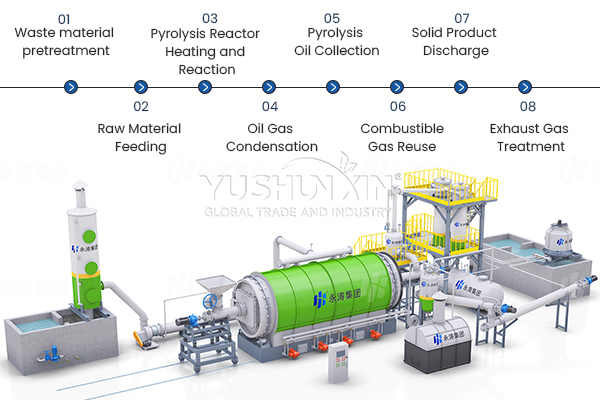
A suitable condenser can improve oil recovery, reduce pipeline blockage and make maintenance easier. For plastic pyrolysis, wax control is especially important. For oil sludge or mixed waste, oil-gas separation and purification should be reviewed more carefully. Safety configuration also affects cost. Water seal, flame arrester, gas purification, pressure control and proper pipeline design help reduce operation risk.

The discharge system is often overlooked but has a direct impact on daily operations. Front-end discharge is more economical and suits projects with lower labor costs. Rear water-cooled discharge increases the initial investment but creates a much cleaner working environment, reduces carbon black dust, and shortens cooling time between batches. If your project is in a region with strict workplace standards (e.g., Europe or the Middle East), this is a detail you should clarify early on.

Emission requirements vary by country. A complete pyrolysis line may need flue-gas treatment, desulfurization, exhaust purification and duct collection to meet local standards.

When comparing quotations, check which environmental systems are included and whether they satisfy local approval requirements. Non-compliance can cause fines, shutdowns or project delays.

A PLC control system is most valuable for projects that require stable operation, reduced labor dependence, production data recording and remote fault diagnosis. Although it increases the initial investment, it often lowers operating risk during long-term production.

Yushunxin provides installation support covering layout planning, civil work guidance, equipment commissioning and operator training. Our technical team also offers after-sales service to support stable operation, routine maintenance and troubleshooting after project delivery.

Yushunxin can provide project-based support, including layout consultation, installation guidance, commissioning assistance, and operator training. For overseas customers, this support is crucial—the real value of your investment begins when the equipment runs safely and continuously at your site.

Pyrolysis Machine Price Guide: What Buyers Should Check Before Requesting a Quote

If you are searching for a Pyrolysis Machine Price, you’ve likely noticed that quotes for similar-capacity equipment can vary wildly—one supplier offers $80,000, while another asks for over $150,000. But does a higher price mean better quality, or does a lower one represent better value? The answer is rarely about capacity alone. In most cases, the final quotation reflects a complex combination of reactor design, automation, environmental compliance, and, critically, what’s not included.

As a professional waste pyrolysis equipment manufacturer, Yushunxin provides this guide not to give you a single number, but to help you understand the cost structure. This way, you can compare quotations based on real project value and avoid costly surprises after delivery.

Yushunxin waste recycling pyrolysis machine
$
Understand Real Cost
Price varies by configuration,
not just capacity.
Compare Smartly
Look beyond the quote,
check what's included.
Invest for the Future
Quality equipment ensures
long-term profit.

How Much Does a Pyrolysis Machine Usually Cost?

For international recycling projects, the budget primarily depends on the operating mode. A small skid-mounted or pilot unit is ideal for testing feedstock and local markets, typically starting around USD 30,000–60,000. A commercial batch waste pyrolysis machine offers the best entry point for most new projects, ranging from USD 70,000–120,000. For stable, high-volume operations, semi-continuous (USD 150,000–350,000) and fully continuous (USD 600,000+) systems deliver greater efficiency but require higher upfront investment.

Machine Type

Typical Application

Estimated Price Range

Laboratory Unit

Technology testing

USD 30,000–50,000

Batch Plant

Small and medium recycling projects

USD 50,000–120,000

Semi-continuous Plant

Commercial production

USD 120,000–300,000

Fully Continuous Plant

Large industrial recycling facilities

USD 600,000–1,000,000+

What Decides Pyrolysis Machine Price?

Quote

Item Why It Matters

Reactor

Determines heating efficiency, sealing and service life

Feeding System

Affects labor cost and material adaptability

Condensation System

Influences oil recovery and blockage risk

Safety System

Reduces backfire and gas operation risk

Environmental System

Supports local approval and stable operation

Installation Support

Helps overseas projects start faster

Operating Mode Changes the Investment Structure

Batch Pyrolysis Plant — Best for Unstable Feedstock

  • Lower first investment
  • Handles wider material fluctuation
  • Cycle operation: feed, heat, cool, discharge
  • Suitable for mixed plastics, high-moisture or irregular supply
  • Easier to start, easier to adjust
Batch model waste pyrolysis machine

Continuous Pyrolysis Plant — Best for Stable Daily Supply

  • Higher automation investment
  • Better rhythm and labor efficiency
  • Requires sorting and pre-treatment plan
  • Stronger uniformity requirements
  • Better for long-term operation and scale-up
Continuous waste recycling pyrolysis plant

The reactor is the core of a pyrolysis plant. Its size, steel grade, wall thickness, welding and sealing directly affect cost, safety and service life.

Yushunxin customizes the reactor to the feedstock and project conditions. Q345R boiler steel suits most tyre and plastic projects, while corrosive materials may require stainless steel such as 304 or 316. Higher-grade construction costs more initially but can reduce maintenance and improve long-term reliability.

A suitable condenser can improve oil recovery, reduce pipeline blockage and make maintenance easier. For plastic pyrolysis, wax control is especially important. For oil sludge or mixed waste, oil-gas separation and purification should be reviewed more carefully. Safety configuration also affects cost. Water seal, flame arrester, gas purification, pressure control and proper pipeline design help reduce operation risk.

The discharge system is often overlooked but has a direct impact on daily operations. Front-end discharge is more economical and suits projects with lower labor costs. Rear water-cooled discharge increases the initial investment but creates a much cleaner working environment, reduces carbon black dust, and shortens cooling time between batches. If your project is in a region with strict workplace standards (e.g., Europe or the Middle East), this is a detail you should clarify early on.

Emission requirements vary by country. A complete pyrolysis line may need flue-gas treatment, desulfurization, exhaust purification and duct collection to meet local standards.

When comparing quotations, check which environmental systems are included and whether they satisfy local approval requirements. Non-compliance can cause fines, shutdowns or project delays.

A PLC control system is most valuable for projects that require stable operation, reduced labor dependence, production data recording and remote fault diagnosis. Although it increases the initial investment, it often lowers operating risk during long-term production.

Yushunxin provides installation support covering layout planning, civil work guidance, equipment commissioning and operator training. Our technical team also offers after-sales service to support stable operation, routine maintenance and troubleshooting after project delivery.

Yushunxin can provide project-based support, including layout consultation, installation guidance, commissioning assistance, and operator training. For overseas customers, this support is crucial—the real value of your investment begins when the equipment runs safely and continuously at your site.