What Is the Pyrolysis Temperature for Tires and Plastics?
The pyrolysis temperature for tires and plastics usually follows several heating stages rather than one fixed setting. Major thermal cracking commonly occurs between 350°C and 500°C, while the best operating range depends on feedstock composition, particle size and target products. Tire pyrolysis requires steady rubber decomposition. Plastic pyrolysis must also control melting, wax formation and condensation.
How Do Different Feedstocks Behave During Pyrolysis?
|
Feedstock |
Early Heating Stage |
Main Reaction Stage |
Main Control Concern |
|
Waste tires |
Moisture removal and rubber softening |
Main oil-gas release |
Uniform heating and gas flow |
|
PE/PP plastics |
Softening and melting |
Oil, gas and wax formation |
Agglomeration and wax control |
|
PS plastics |
Softening |
Aromatic-rich vapor release |
Condensation matching |
|
PVC-rich waste |
Not recommended as a main feedstock |
Acidic gas generation |
Sorting and dechlorination |
What Is the Suitable Pyrolysis Temperature for Tires?
Waste tire recycling plants may process whole tires, tire blocks, rubber chips or production scraps. Larger materials need slower and more uniform heating.
The reactor first raises the tire temperature gradually. Moisture and light volatile compounds leave during this stage, while the rubber begins to soften.
Whole tires and large blocks require enough preheating time. Rapid heating can create uneven reactions, sudden gas release and pressure changes.
Tire rubber begins active decomposition as the reactor temperature continues to rise. The strongest oil and gas release often occurs around 360–450°C.
Within this range, rubber converts into:
- Pyrolysis oil vapor
- Combustible gas
- Carbon black
- Steel wire
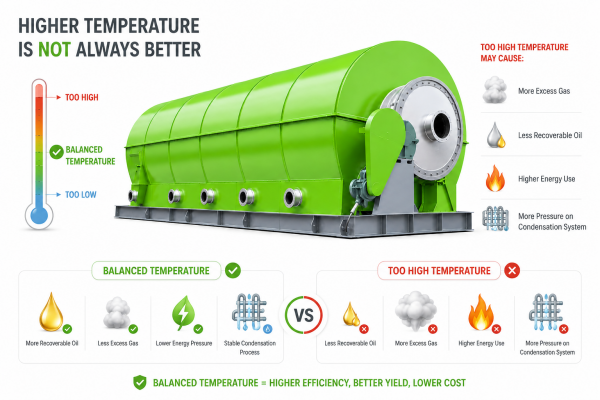
Low temperatures may leave part of the rubber incompletely treated. Excessive heat can increase secondary cracking and convert more oil vapor into gas.
Temperature alone does not determine oil recovery. The plant must coordinate heating rate, gas flow and condensation capacity.
A stable process releases oil vapor gradually and gives the condenser enough time to recover it. Poor coordination may cause pressure fluctuation, lower oil collection or heavier deposits inside the gas line.
What Is the Suitable Pyrolysis Temperature for Plastics?


Is a Higher Pyrolysis Temperature Always Better?