

Oil Sludge Pyrolysis Line Price: How to Budget a Complete Treatment System
A lower quotation does not always mean a lower project cost. In oil sludge recycling, two production lines with similar processing capacity may differ significantly in configuration, operating efficiency, environmental performance, and long-term maintenance requirements.As a pyrolysis equipment manufacturer, Yushunxin analyzes oil sludge pyrolysis line price from a practical project perspective to help buyers understand what affects the budget before requesting a quotation.
What Factors Affect Oil Sludge Pyrolysis Line Price?
Hazardous waste compliance configuration is the core cost variable first
Unlike waste tire pyrolysis plants which mainly follow general solid waste emission standards, oil sludge pyrolysis lines must first meet local hazardous waste disposal regulations. Although it increases the initial investment, it is a necessary condition for project approval and long-term operation.

Processing capacity is the second core factor
Larger capacity means larger reactors, more robust pretreatment systems, and more efficient resource recovery configurations, but the cost growth is not linear with capacity, because the pretreatment difficulty of oil sludge varies greatly with its quality. The investment may range from approximately USD 30,000 for a small batch line to over USD 1,000,000 for an integrated industrial treatment system.
|
Project Scale |
Typical Application |
Estimated Price Range |
|
Small 1–5 TPD Batch Line |
Dewatered sludge or pilot treatment |
USD 30,000–60,000 |
|
10–15 TPD Batch Line |
Refinery sludge or tank bottom sludge |
USD 70,000–120,000 |
|
15–20 TPD Semi-continuous Line |
Stable sludge supply with pretreatment |
USD 120,000–280,000 |
|
30–50 TPD Integrated Line |
Centralized refinery or oilfield treatment |
USD 650,000–1,000,000+ |

Reactor design determines the core manufacturing cost
The reactor of oil sludge pyrolysis line has completely different requirements from that of waste tire pyrolysis plants: it needs to handle viscous oil-solid mixtures, and has higher requirements for corrosion resistance, sealing performance and stirring performance.
- Material selection: Oil sludge with high sulfur, chlorine or corrosive components may require acid-resistant stainless-steel lining or special alloys instead of standard Q345R.
- Structural design: Internal heating and stirring help prevent coking, while high-integrity sealing reduces VOC leakage. Yushunxin customizes the reactor according to sludge composition, balancing cost and service life.
Pretreatment complexity affects the total investment significantly
Unlike waste tires that can be directly fed after simple sorting, oil sludge usually needs pretreatment according to its oil content, water content and impurity content:
- High oil content (>30%) oil sludge only needs simple dehydration pretreatment, with low additional cost;
- Low oil content (<10%) contaminated soil type oil sludge needs extra oil extraction pretreatment, which will increase the total investment ;
- Oil sludge with a large amount of impurities (such as drilling cuttings, sand) needs to be equipped with impurity screening and removal systems, which will increase the investment by about 10%.
Resource recovery and tail gas treatment configuration have a greater impact than expected
Different project positioning requires completely different configurations for resource recovery and tail gas treatment:
|
Optional Configuration |
Effect on Investment |
Recommended For |
|
Oil sludge pretreatment dehydration/deoiling system |
High |
Low-grade oil sludge with oil content <15%, contaminated soil type oil sludge |
|
Corrosion-resistant reactor liner/special alloy material |
Medium-High |
High-sulfur, high-chlorine oil sludge, extend equipment service life |
|
Multi-stage fractionation and purification system |
Medium |
Projects with high requirements for pyrolysis oil quality, needing to connect to refineries |
|
Online VOC/dioxin monitoring system |
Medium |
Areas with strict environmental supervision (EU, China key control zones etc.) |
|
Carbon residue passivation system |
High |
Projects where carbon residue needs to be landfilled in compliance and cannot be sold as fuel |
|
Fully automatic closed conveying system |
Low-Medium |
Projects with high labor costs, needing to reduce frontline staff’s contact with hazardous waste |
Beyond Equipment Configuration: Additional Costs You Need to Reserve
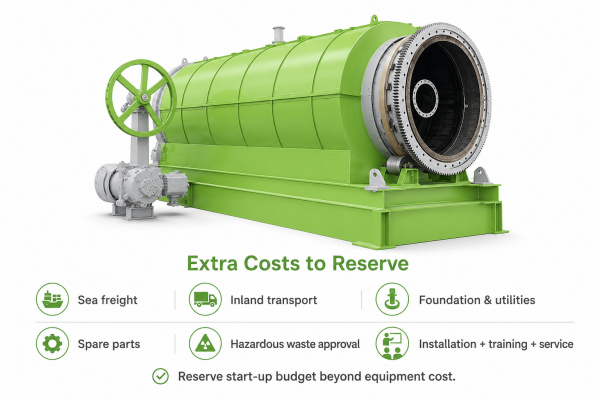
In addition to the oil sludge pyrolysis equipment cost, you also need to reserve budget for project landing costs, including sea freight, inland transportation, foundation construction, power and water connection, spare parts preparation, and hazardous waste disposal qualification application consulting, environmental acceptance services, and hazardous waste transportation system docking. To reduce start-up pressure, Yushunxin provides free installation guidance, commissioning, operator training and one-year after-sales service, helping customers move from equipment delivery to stable operation more smoothly.
The goal is not to buy the cheapest machine, but to buy the most suitable one.
- Start with a batch plant if your oil sludge supply is still unstable, and upgrade to semi-continuous production after the feedstock source is stabilized;
- Select environmental and pretreatment configurations strictly according to local hazardous waste disposal standards, avoid unnecessary over-configuration;
- Recover combustible gas generated during pyrolysis for reactor heating, which can reduce 60% of external fuel consumption;
Instead of comparing quotations alone, investors should evaluate the complete project, including equipment configuration, compliance service, installation, commissioning, operating cost, maintenance requirements, and expected oil recovery rate.


