

Batch vs Semi vs Full Continuous Pyrolysis Plant
Choosing a pyrolysis plant is essentially choosing the operating structure of your recycling project. Batch pyrolysis plant, semi continuous and full continuous pyrolysis plant is not only a comparison of machine types; it is a comparison of production rhythm, material tolerance, automation depth and long-term operating pressure. For investors handling waste tires, plastics, oil sludge or solar panel materials, the right structure should make daily operation easier to control, not more complicated after installation.

How To Choose?
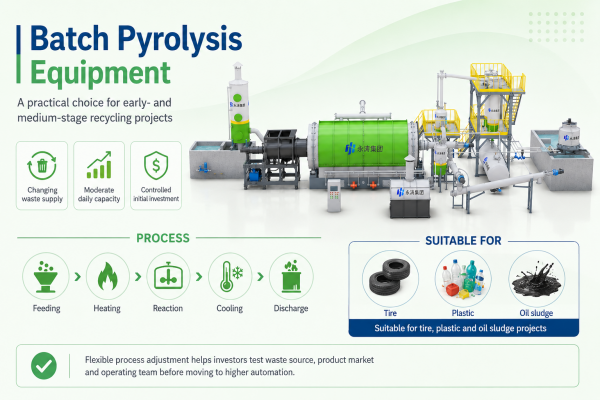
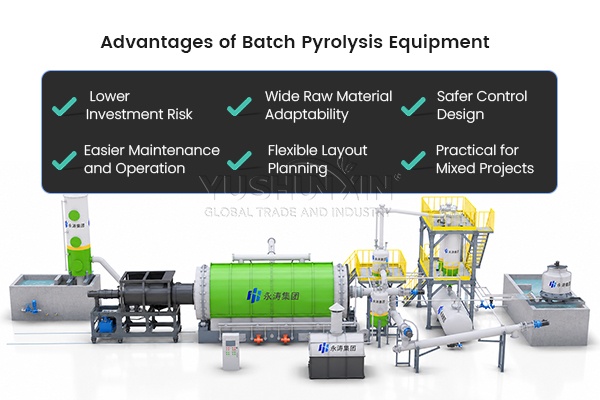
- Choose Batch if your waste source is unstable or you want more flexibility.
- Choose Semi Continuous if you want more stable output with reasonable investment.
- Choose Full Continuous if you pursue high efficiency, low labor cost and long-term large-scale operation.
How Does Batch Type Configuration Support Flexible Pyrolysis Projects?
How Can Semi-Continuous Type Improve Turnover Without Overbuilding?
A semi-continuous pyrolysis plant is suitable for projects that have passed the trial stage but do not yet need a fully continuous industrial line. Compared with batch operation, the semi-continuous structure usually improves feeding, discharge or heat utilization efficiency. It helps the plant reduce idle time between cycles and increase daily turnover without immediately moving to a much larger investment scale.
In the pyrolysis plant comparison, semi-continuous type often works as a transitional solution. It is more efficient than batch type, but less demanding than full-continuous operation. This makes it attractive for tire recycling plants, plastic recovery projects or oil sludge treatment sites that already have regular material supply but still want to keep capital risk under control.
Once the plant moves toward semi-continuous operation, feedstock preparation becomes more important. The feeding system needs more stable material size and smoother conveying conditions. Oversized tire pieces, sticky plastic lumps or highly inconsistent sludge may affect feeding stability and overall production rhythm. This is why semi-continuous projects should not only consider the reactor, but also the pretreatment and conveying system around it.
For customers, the value of semi-continuous type lies in controlled improvement. It can reduce part of the manual workload, shorten non-productive time and make the plant cleaner than a traditional batch layout. But it should still match the actual supply chain. If the raw material source is not stable enough, upgrading too quickly may create new operating pressure instead of solving the original problem.
If your plant has regular orders, rising disposal volume and a team that can manage basic automation, semi-continuous type can improve project competitiveness. It gives the business a stronger production rhythm while keeping investment more manageable than a fully continuous line. For many investors, this is the point where pyrolysis moves from “testing a project” to “building a repeatable operation.”
The key is to identify your real bottleneck. If your batch system loses too much time in cooling and discharge, semi-continuous equipment may bring visible improvement. If your problem is inconsistent material supply, limited pretreatment capacity or weak operator training, the upgrade should be planned more carefully. A good semi-continuous project is not overbuilt; it is upgraded at the right time.


What Makes Full-Continuous Type Operation Suitable for Industrial Projects?
A full-continuous pyrolysis plant is designed for long-cycle production. Its strength is not only higher capacity, but also stable feeding, continuous reaction, sealed discharge, automated control and more consistent product output. For buyers studying pyrolysis plant, this structure is usually attractive when the project already has secured feedstock supply and clear downstream outlets.
However, full-continuous operation is not suitable for every investor. It requires better raw material preparation, stronger site planning and a more professional operation team. If feedstock size is unstable or the plant cannot support smooth conveying, the system may not reach its expected performance. Continuous equipment should be treated as an industrial production line, not simply as a larger reactor.
For industrial recycling projects, the value of full-continuous type is especially clear in labor control, environmental management and operating consistency. Sealed feeding and sealed discharge help reduce dust exposure. Automated control can coordinate feeding speed, heating rhythm and discharge performance. This is important for plants that need cleaner workshops, more standardized management and stronger compliance capability.
The initial investment is usually higher, but the long-term logic is different. Full-continuous equipment aims to reduce repeated heating and cooling, lower manual intervention and support stable production scheduling. If your project is designed for long-term operation rather than short-term market testing, this structure can help build stronger processing capacity and more predictable daily output.


