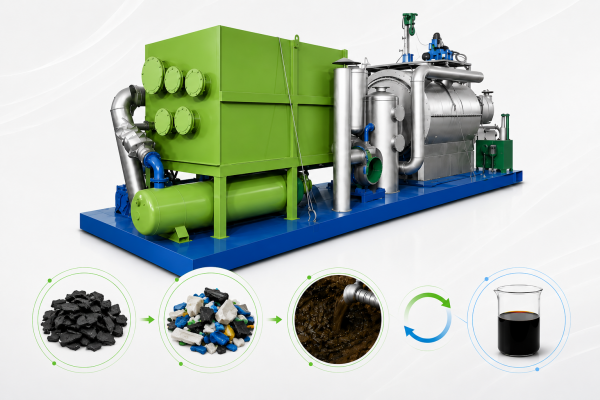
20 TPD Semi-Continuous Pyrolysis Plant

How Is the Semi-Continuous Pyrolysis System Configured?
Each section is configured according to the production flow.
A semi-continuous pyrolysis system is usually configured according to the actual material flow: pretreatment, screw feeding, reactor heating, oil gas recovery, combustible gas reuse, rear hot discharge, carbon black cooling, tail gas treatment and electrical control. Each section affects feeding stability, oil recovery efficiency, discharge speed and long-term operation.

|
Feedstock Form |
Typical Materials |
Project Evaluation Focus |
|
Whole or Large-Size Materials |
Whole tires, cut tires, tire blocks, conveyor belt waste |
Feeding method, reactor loading, pretreatment cost |
|
Shredded or Irregular Solids |
Tire chips, rubber scraps, plastic scraps, cable skin waste |
Material size, impurity level, oil recovery potential |
|
Sorted Plastics |
PE, PP, PS, selected ABS plastics |
Oil yield, condensation efficiency, de-waxing requirement |
|
Mixed or Composite Waste |
Mixed plastics, aluminum-plastic waste, packaging scraps |
Sorting need, chlorine risk, residue separation |
|
Oil-Based Materials |
Oil sludge, tank bottom sludge, oily waste |
Oil content, moisture, viscosity, sealed feeding, residue discharge |
Product application affects project return.
Product application directly affects project returns. Waste tires, plastics and oil sludge generate different products, so buyers should evaluate local demand, product (pyrolysis oil, carbon black, solid residue ) use and residue disposal before selecting a pyrolysis solution. The table below summarizes the main outputs and their common applications.
|
Recovered Product |
Main Source |
Application |
|
Pyrolysis Oil |
Waste Tires / Waste Plastics / Oil Sludge |
1. Used as industrial fuel in boilers, furnaces, cement plants, brick factories and steel plants. 2. Further refining can produce diesel-range fuel for industrial heating, generators and heavy machinery. |
|
Recovered Carbon Black |
Waste Tires |
1. Sold as fuel-grade carbon material or ground into fine powder. 2. Pressed into briquettes to improve storage, transportation and fuel use. |
|
Solid Residue |
Oil Sludge |
Non-hazardous residue may be used in suitable construction materials after testing and local compliance approval. |
|
Combustible Gas |
Waste Tires / Waste Plastics / Oil Sludge |
Returned to the burner system after purification and safety treatment to heat the reactor and reduce external fuel consumption. |
Advantages of Semi-Continuous Pyrolysis Equipment
Semi-continuous pyrolysis equipment combines mechanical feeding, high-temperature residue discharge and flexible production control. With a typical capacity of 5–20 TPD, it suits commercial projects that have stable feedstock supply and need higher efficiency without excessive investment.

Which Yushunxin Models Can Be Selected for 8–20TPD Projects?
Model selection should match feedstock, working cycle and site conditions.
Yushunxin provides YSX-S8, YSX-S10, YSX-S12, YSX-S15 and YSX-S20 semi-continuous pyrolysis equipment for different 8–20TPD project requirements. Final capacity should be calculated according to raw material type, feeding size, loading condition, heating time, discharge efficiency and actual working schedule.
|
Model |
YSX-S8 |
YSX-S10 |
YSX-S12 |
YSX-S15 |
YSX-S20 |
|
Capacity Per Batch |
8 Tons |
10 Tons |
12 Tons |
15 Tons |
20 Tons |
|
Reactor Size |
2200×6000 mm |
2200×6600 mm |
2800×8000 mm |
2600×6600 mm |
2800×6600 mm |
|
Reactor Thickness |
14-22 mm |
14-22 mm |
14-22 mm |
14-22 mm |
14-22 mm |
|
ReactorMaterial |
Q345R / SS304 / SS310 / SS316 |
Q345R / SS304 / SS310 / SS316 |
Q345R / SS304 / SS310 / SS316 |
Q345R / SS304 / SS310 / SS316 |
Q345R / SS304 / SS310 / SS316 |
|
Heating Method |
Direct Burner Heating |
Direct Burner Heating |
Direct Burner Heating |
Direct Burner Heating |
Direct Burner Heating |
|
Fuel Type |
LPG / Diesel / Natural Gas |
LPG / Diesel / Natural Gas |
LPG / Diesel / Natural Gas |
LPG / Diesel / Natural Gas |
LPG / Diesel / Natural Gas |
|
Discharging Method |
Rear Optional |
Rear Optional |
Rear Optional |
Rear Optional |
Rear Optional |
|
Working Temperature |
450–520°C |
450–520°C |
450–550°C |
450–520°C |
450–520°C |
|
Container Loading |
2×40HQ |
2×40HQ |
1×40FR + 1×40HQ |
1×40FR + 1×40HQ |
1×40FR + 1×40HQ |
|
Land Requirement |
300–500 m² |
||||
|
Working Cycle |
2days three batchs |
||||
- Projects still testing feedstock stability can start with the YSX-S8 or YSX-S10. These semi-continuous pyrolysis models are easier to operate and manage.
- Once feedstock supply and oil sales become stable, the YSX-S12, YSX-S15 or YSX-S20 can support higher output. Final selection should match the project budget, site layout and target production rhythm.