

Un client indien a commandé une usine de pyrolyse du caoutchouc entièrement continue
India has a well-established tyre-recycling and reclaimed-rubber industry, but the market is moving beyond basic material reuse. National policy now places greater attention on traceability, product quality and cleaner recycling. NITI Aayog reports that pyrolysis handles a major share of the country’s waste tyres, while the sector still needs stronger standards for tyre pyrolysis oil and noir de carbone récupéré. This creates opportunities for formal recyclers with stable processing and environmental control.
Why Did the Indian Customer Expand Into Pyrolysis?


Why Was a Fully Continuous Pyrolysis Plant Selected?

What Did the Customer Focus on Before Ordering?
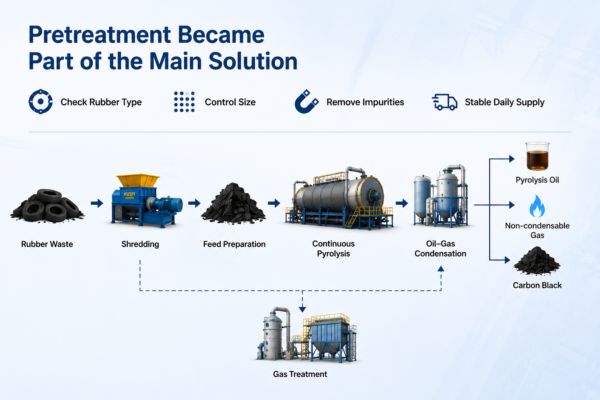
The customer wanted a predictable production rhythm rather than the largest nominal capacity. Discussions covered working hours, maintenance access, storage, power supply, cooling water and fuel conditions.
Recovered oil formed an important part of the investment plan. Yushunxin matched the reactor with oil-gas separation, condensation, oil storage and gas purification. The customer also reviewed local oil applications and possible quality requirements.
India’s waste-tyre sector operates under an EPR framework, while policymakers are calling for tighter control of pyrolysis facilities. For this reason, the project treated environmental systems as part of the core plant. The solution considered sealed feeding, negative-pressure operation, combustible-gas reuse, exhaust treatment and safety monitoring.


