Indian Customer Ordered Fully Continuous Rubber Pyrolysis Plant

India has a well-established tyre-recycling and reclaimed-rubber industry, but the market is moving beyond basic material reuse. National policy now places greater attention on traceability, product quality and cleaner recycling. NITI Aayog reports that pyrolysis handles a major share of the country’s waste tyres, while the sector still needs stronger standards for tyre pyrolysis oil and recovered carbon black. This creates opportunities for formal recyclers with stable processing and environmental control.

Why Did the Indian Customer Expand Into Pyrolysis?

Mechanical Recycling Rubber

Mechanical Recycling Could Not Use Every Rubber Stream

The customer already operated in the reclaimed-rubber sector, producing rubber powder, reclaimed rubber and other basic recycled materials.
However, mechanical recycling could not absorb every type of rubber residue. Some materials had limited resale value, while demand for lower-grade recycled rubber could fluctuate. The customer therefore planned to expand from material recovery into waste-to-fuel recycling.

Multiple Products Reduced Dependence on One Market

Pyrolysis created three additional product routes: recovered oil, carbon-rich residue and reusable gas. Instead of relying only on rubber powder sales, the company could obtain more value from its existing waste-rubber supply.
Before investing, the customer also evaluated local oil applications, carbon-product demand, feedstock costs and long-term operating expenses.

Tyre oil application

Why Was a Fully Continuous Pyrolysis Plant Selected?

Stable feedstock supported continuous pyrolysis production

Stable Feedstock Supported Continuous Production

The customer had a regular supply of waste rubber and planned consistent daily operation. A batch plant would require repeated loading, cooling and discharge, which did not match the expected industrial production rhythm.
A fully continuous pyrolysis plant uses prepared and uniform feedstock with continuous feeding and discharge. This reduces cycle interruptions, limits manual handling and supports centralized control.

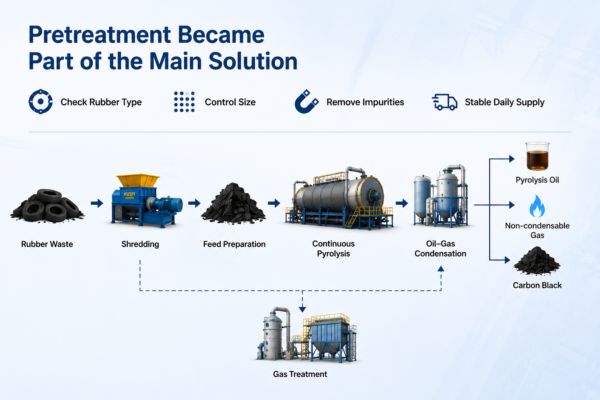
Pretreatment Became Part of the Main Solution

Stable operation depends on suitable particle size, impurity removal reliable feed preparation and quality of pyrolysis machine. Yushunxin therefore reviewed the rubber type, material size, metal content and daily supply before confirming the line.

The proposed route connected shredding and feed preparation with sealed conveying, continuous pyrolysis, oil-gas condensation, carbon discharge and gas treatment. This reduced the risk of steel wires, oversized material or unstable feed density interrupting the production line.

Pretreatment of waste tire for pyrolysis

What Did the Customer Focus on Before Ordering?

After order confirmation, We can provide support from process design to equipment production, packaging, shipment, installation guidance, commissioning support, and operator training.

If you are interested in setting up a waste rubber pyrolysis plant, tire pyrolysis plant, or continuous pyrolysis system in India, contact YUSHUNXIN to get a customized process design, equipment configuration, and project quotation plan.