

Pyrolysis Oil to Diesel Refining Distillation Machine
Upgrade Oil Value
Improve quality and
market price
Broader Fuel Use
Boilers, generators,
machinery & more
Higher Profit Space
Reduce dependence on
low-end traders
Cleaner Operation
Better purification,
lower odor & emission

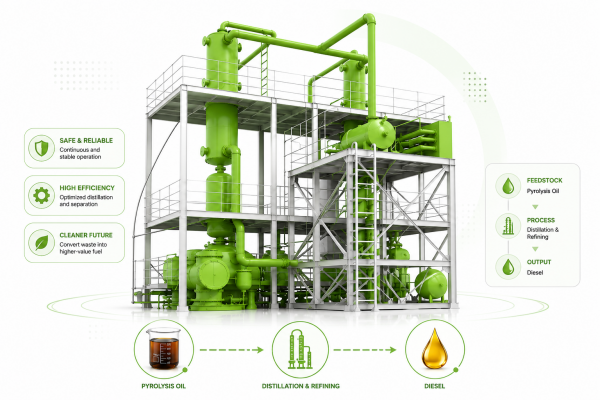
What Is a Pyrolysis Oil to Diesel Refining Distillation Machine?
Two distillation technology process routes are available
Other waste oils that can be processed
Besides pyrolysis oil, the machine can also be evaluated for used engine oil, waste motor oil, waste engine oil, motor oil, used lube oil, crude oil, black oil and other waste oil streams. This is especially useful for customers who already collect industrial waste oil, garage oil, machinery maintenance oil or mixed fuel oil from different sources. Before choosing acid-alkali washing or catalyst upgrading, the oil should be checked for water content, sediment, viscosity, sulfur, chlorine, wax and impurity level. Different oils should not be treated as the same material, because their refining behavior, residue amount and final fuel quality may vary greatly.
Used Engine Oil
Waste Motor Oil
Waste Engine Oil
Motor Oil
Used Lube Oil
Crude Oil
Black Oil
Other Waste Oil
How Does Distillation Improve Oil Value?
The refining process usually starts from oil storage and sedimentation. Heavy particles, water and visible impurities should be reduced as much as possible before feeding. This step protects the distillation reactor, improves heating stability and reduces the risk of blockage, heavy residue load and unexpected shutdown.
The oil is pumped into the distillation reactor and heated indirectly. As the temperature rises, water vapor, light oil gas and heavier fractions separate gradually. For many pyrolysis oil distillation projects, the main distillation stage may operate around 320–400℃, depending on oil composition and system design. These figures should be treated as engineering references, not fixed promises. Final parameters need adjustment after checking the oil sample and confirming the selected purification route.
After vapor generation, the oil gas passes through fractionation, purification and condensation. The condensed light oil is collected for further treatment or storage. The following purification section may include deodorization, decolorization, acid-alkali washing, catalyst treatment, filtration or residue separation. The purpose is to improve appearance, odor, stability and usability so that the final fuel can better match generators, boilers, heating furnaces, heavy machinery or industrial fuel buyers.
What Final Fuel Can You Realistically Expect?

Used in industrial boilers, furnaces, diesel generators, agricultural machinery, construction equipment, mining machinery, ships or heavy-duty engines.

Heavy residue or asphalt-like byproduct can be sold to asphalt-related users or used as heavy industrial fuel where allowed.

Guided back to the heating system after safety treatment to reduce part of external fuel demand.


