Pyrolysis Carbon Black Upgrading Line for Conductive Material Applications

Waste tire pyrolysis converts one waste stream into several recoverable products. Pyrolysis oil, steel wire and combustible gas provide direct revenue or energy value. Recovered carbon black creates another important opportunity.
Instead of selling all pyrolysis carbon black as a basic fuel or low-cost filler, project owners can develop part of the carbon output for conductive material applications. Purification, graphitization and particle finishing can increase its technical value and connect the pyrolysis project with more specialized carbon markets.

Higher Product Value

Refining carbon black to a higher grade brings stronger market competitiveness and better prices.

Better Particle Control

Advanced grinding and classification ensure stable particle size and consistent product quality.

Broader Sales Route

Qualified carbon black can enter battery, rubber, plastic, coatings and other high-demand industries.

Support for Conductive Applications

Meets the requirements of conductive additives and functional material applications.

Yushunxin plans the pyrolysis section around both immediate carbon recovery and future upgrading. This gives customers a clearer route from waste tire treatment to higher-value carbon products.

How Does Tire Pyrolysis Create a Carbon Feedstock for Conductive Materials?

During tire pyrolysis, rubber compounds decompose in an oxygen-limited environment. Oil vapor and combustible gas leave the reactor, while carbon-rich solids and steel wire remain. After controlled discharge, cooling and steel separation, the recovered carbon can enter different sales routes. Some projects sell it as raw recovered carbon black. Others add grinding, briquetting or pelletizing. Projects targeting conductive materials can reserve an interface for purification and graphitization.

This flexibility matters because the same pyrolysis plant can support several carbon product levels:

Carbon Product Route

Typical Processing Depth

Potential Market Direction

Processing Depth:

Raw recovered carbon

Cooling and steel separation

Fuel and basic industrial uses

★☆☆☆☆

Processed carbon powder

Grinding and classification

Rubber, plastic and construction fillers

★★☆☆☆

Pelletized carbon

Mixing and pelletizing

Easier storage, transport and dosing

★★★☆☆

Purified graphitized carbon

Purification, graphitization and fine finishing

Conductive additives and advanced carbon materials

★★★★☆

The value of the pyrolysis plant therefore comes from more than oil production. It also creates a continuous carbon feedstock that can be upgraded according to local buyers and investment plans.

Why Can Graphitization Increase the Conductive Potential of Pyrolysis Carbon Black?

Graphitization applies controlled ultra-high-temperature treatment to carbon material. This treatment can increase the ordering of the carbon structure and improve its potential for electrical and thermal conduction. The source report identifies approximately 2600–3000℃ as a main graphitization range. Projects with more demanding product targets may evaluate systems operating between 3000℃ and 3200℃.

For waste pyrolysis project owners, the important point is that recovered carbon black already provides the carbon-containing feedstock. The downstream line then focuses on increasing purity, improving structural consistency and controlling the finished particle size.

This creates a value-development route:
Waste tires → pyrolysis carbon black → purified carbon → graphitized carbon → conductive material feedstock.

Waste Tires

Pyrolysis

Pyrolysis
Carbon Black

Grinding &
Purification

Classification /
Pelletizing

Conductive Material
Applications

How Is Pyrolysis Carbon Black Upgraded into Graphitized Carbon?

The source report proposes the following complete route:
Pyrolysis carbon black → crushing and grinding → acid or alkaline purification → filtration and drying → high-temperature graphitization → grinding and air classification → demagnetization → vacuum packaging

Initial grinding opens agglomerated carbon and improves particle consistency. This helps the purification system contact the carbon more evenly.
The grinding configuration should match the incoming carbon size, daily output and downstream purity target.

Purification reduces ash and selected metal impurities. The report states that demanding products may require ash to be controlled below 0.1%, subject to the actual buyer specification and test method.
This stage can include reaction tanks, washing, filtration, filter pressing and wastewater-treatment interfaces.
From a project-value perspective, purification changes the carbon from a broadly defined solid product into a more controlled industrial feedstock.

After washing and filtration, controlled drying reduces moisture before ultra-high-temperature treatment.
Stable moisture supports consistent feeding and reduces unnecessary heat consumption. It also helps maintain repeatable furnace operation.

The purified carbon enters a batch or continuous graphitization furnace.
The furnace temperature, residence time, atmosphere and heating system should match the target product. A conductive additive project may use different conditions from a battery anode-related development project.
The selection should therefore begin with the intended market rather than only the highest available furnace temperature.

After graphitization, grinding and air classification control the finished particle distribution.
Demagnetization reduces residual ferromagnetic contamination. Sealed or vacuum packaging then protects the material from moisture and external impurities.
These finishing steps help the customer produce repeatable batches for downstream evaluation.

Which High-Conductivity Applications Can Be Evaluated?

The report identifies conductive agents, lithium battery anode-related materials and rubber reinforcement as possible target directions. The final route depends on purity, graphitization degree, particle size and buyer specifications.

Yushunxin batch pyrolysis equipment is designed for practical waste recycling projects that require flexible raw material handling, stable operation, safe gas control and project-based configuration.

Carbon materials are used in selected rubber and plastic formulations to build conductive or antistatic pathways.
For this market, buyers may evaluate electrical resistance, dispersion, particle distribution and the required carbon loading. A consistent graphitized carbon powder can provide project owners with a higher-value direction than basic fuel use.
Potential applications include conductive rubber products, antistatic plastic components, cable compounds and selected masterbatch formulations.

Graphitized carbon may be evaluated as a conductive component in selected battery material systems.
This direction normally requires tighter control of ash, magnetic contaminants, moisture and particle size. Buyer testing also becomes more important because battery material manufacturers usually have their own acceptance standards.
The opportunity remains attractive because battery-related carbon materials generally require more processing and technical control. This creates room for greater product differentiation and deeper cooperation with downstream buyers.

Graphitized carbon can also be evaluated for engineered carbon composites and other functional material systems.
Different applications may focus on electrical conductivity, thermal conductivity, wear resistance or carbon content. This allows customers to develop several product grades instead of relying on one sales route.

Finely processed graphitized carbon may enter development projects for conductive coatings, antistatic coatings and selected carbon-based formulations.
These buyers usually care about fine particle control, dispersion and contamination. Therefore, grinding, air classification and protected packaging become important finishing stages.
The final application should always be verified with the intended buyer. However, the pyrolysis project already provides the essential starting material for this development route.

What Added Value Can Conductive Carbon Create for a Pyrolysis Project?

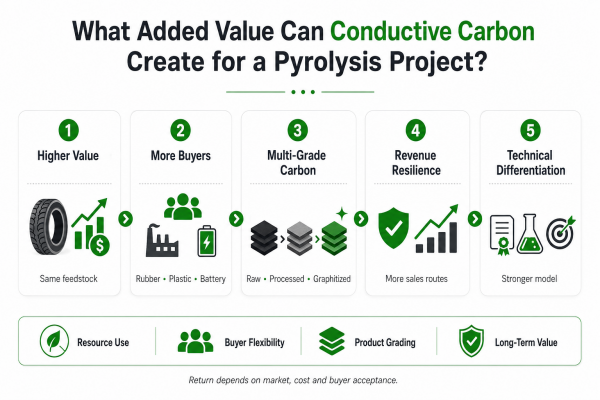
Developing conductive material applications can improve the business structure of a waste tire pyrolysis project in several ways.

A pyrolysis plant already produces carbon black as one of its main solid products. Upgrading does not require the customer to purchase another waste feedstock.
The project extracts more value from the same tire supply. Oil, steel and gas maintain their original routes, while part of the carbon output enters a deeper processing chain.
This improves resource utilization per tonne of tires.

Raw carbon may depend heavily on local fuel users or low-cost filler buyers. Processed and graphitized carbon can be introduced to more specialized rubber, plastic, battery material and carbon-product companies.
A wider buyer base can reduce dependence on one outlet. It also gives the project owner more options when local prices change.

The customer does not need to graphitize every tonne of carbon.
A practical project can divide carbon output into several grades. One part may be sold after basic separation. Another part may be ground or pelletized. A selected portion can enter purification and graphitization.
This staged product structure allows the customer to match processing costs with actual buyer demand.

Pyrolysis oil prices, fuel demand and carbon prices can change independently. A project with several product outlets has more flexibility than a project that depends only on oil yield.
Higher-value carbon development can strengthen the overall revenue model. It may also reduce long-term storage pressure when local raw-carbon demand is limited.

Many pyrolysis projects stop at producing oil and raw carbon. A project that plans carbon cooling, separation, purification interfaces and downstream product testing can present a more complete resource-recovery model.
This can improve the project’s position when communicating with industrial partners, environmental authorities and potential investors.
The actual economic return still depends on local carbon prices, upgrading costs, energy consumption and buyer acceptance. However, the conductive material route provides an additional value option that does not exist when carbon is treated only as a low-value by-product.

How Does Yushunxin Connect Pyrolysis with Carbon Upgrading?

Yushunxin focuses first on producing a stable and manageable carbon stream from the waste tire pyrolysis line. The upstream solution can include tire preparation, sealed feeding, controlled pyrolysis, carbon discharge, cooling, steel separation, dust collection and carbon storage. When the customer plans future graphitization, we can reserve suitable carbon collection and transfer interfaces. This avoids rebuilding the entire pyrolysis section when the upgrading project begins.

To evaluate the project, customers can provide waste tire availability, expected plant capacity, carbon test data and the intended conductive material application. We can then define the pyrolysis configuration, carbon collection method and downstream upgrading interface.