Pyrolysis Carbon Black Upgrading Line for Conductive Material Applications
Higher Product Value
Refining carbon black to a higher grade brings stronger market competitiveness and better prices.
Better Particle Control
Advanced grinding and classification ensure stable particle size and consistent product quality.
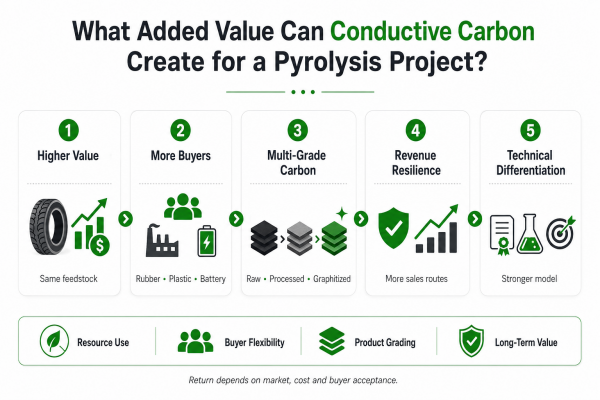
Broader Sales Route
Qualified carbon black can enter battery, rubber, plastic, coatings and other high-demand industries.
Support for Conductive Applications
Meets the requirements of conductive additives and functional material applications.
How Does Tire Pyrolysis Create a Carbon Feedstock for Conductive Materials?
During tire pyrolysis, rubber compounds decompose in an oxygen-limited environment. Oil vapor and combustible gas leave the reactor, while carbon-rich solids and steel wire remain. After controlled discharge, cooling and steel separation, the recovered carbon can enter different sales routes. Some projects sell it as raw recovered carbon black. Others add grinding, briquetting or pelletizing. Projects targeting conductive materials can reserve an interface for purification and graphitization.
This flexibility matters because the same pyrolysis plant can support several carbon product levels:
|
Carbon Product Route |
Typical Processing Depth |
Potential Market Direction |
Processing Depth: |
|
Raw recovered carbon |
Cooling and steel separation |
Fuel and basic industrial uses |
★☆☆☆☆ |
|
Processed carbon powder |
Grinding and classification |
Rubber, plastic and construction fillers |
★★☆☆☆ |
|
Pelletized carbon |
Mixing and pelletizing |
Easier storage, transport and dosing |
★★★☆☆ |
|
Purified graphitized carbon |
Purification, graphitization and fine finishing |
Conductive additives and advanced carbon materials |
★★★★☆ |
The value of the pyrolysis plant therefore comes from more than oil production. It also creates a continuous carbon feedstock that can be upgraded according to local buyers and investment plans.
Why Can Graphitization Increase the Conductive Potential of Pyrolysis Carbon Black?
Graphitization applies controlled ultra-high-temperature treatment to carbon material. This treatment can increase the ordering of the carbon structure and improve its potential for electrical and thermal conduction. The source report identifies approximately 2600–3000℃ as a main graphitization range. Projects with more demanding product targets may evaluate systems operating between 3000℃ and 3200℃.
For waste pyrolysis project owners, the important point is that recovered carbon black already provides the carbon-containing feedstock. The downstream line then focuses on increasing purity, improving structural consistency and controlling the finished particle size.
This creates a value-development route:
Waste tires → pyrolysis carbon black → purified carbon → graphitized carbon → conductive material feedstock.
Waste Tires
Pyrolysis
Pyrolysis
Carbon Black
Grinding &
Purification
Classification /
Pelletizing
Conductive Material
Applications
How Is Pyrolysis Carbon Black Upgraded into Graphitized Carbon?
The source report proposes the following complete route:
Pyrolysis carbon black → crushing and grinding → acid or alkaline purification → filtration and drying → high-temperature graphitization → grinding and air classification → demagnetization → vacuum packaging

Which High-Conductivity Applications Can Be Evaluated?
The report identifies conductive agents, lithium battery anode-related materials and rubber reinforcement as possible target directions. The final route depends on purity, graphitization degree, particle size and buyer specifications.
Yushunxin batch pyrolysis equipment is designed for practical waste recycling projects that require flexible raw material handling, stable operation, safe gas control and project-based configuration.